
Rahway Resident Lookup Coverage by Record
Each Rahway resident lookup needs a question before it needs a search box. A tax record can place a name on an annual assessment snapshot, a deed can document transaction parties, and a court docket can identify a case party and venue. None stands alone as proof of present residence. The table separates what each official or institutional route can actually support from the access limits that govern it.
| Record | What It Confirms | Where | Access |
|---|---|---|---|
| Assessment or parcel record | A tax-roll owner, block/lot, class, and assessed value as of certification | Rahway Tax Assessor, NJ assessment search, and Union County GIS | Online lead; assessor or an OPRA request for a property record card |
| Recorded land instrument | Grantor, grantee, document type, recorded date, and legal description | Union County Clerk UCPA | Online index, published image when available, or record room and certified-copy route |
| Court docket | A party, venue, docket, caption, and proceeding information shown | New Jersey Judiciary | Category-specific public search; request a defined case record when needed |
| Vital record | An eligible event and relationships under the governing copy rules | Rahway registrar, New Jersey DOH, or State Archives | Restricted current copies; separate genealogical access for qualifying older records |
| Business filing | An entity role, registered agent or filing address, and filing status | New Jersey Treasury | State filing services and document-copy options |
For a current property question, start with a dated assessment or parcel clue and then seek the latest recorded instrument. For an event question, use the court category or vital-record custodian that owns that event. A state business result belongs in the file only as entity evidence, because a registered address is not evidence of a private home.
Build a Rahway Identity Match From Two Records
The safest way to look up a Rahway resident is as an identity-resolution exercise. First, tie the name to an address through a current or dated property or municipal record. Next, independently connect that same name to a second attribute, such as a recorded deed, public meeting minute, dated newspaper notice, entity filing, or court docket. Finally, use a date, middle initial, party role, venue, or block/lot to reduce the chance that a namesake has been mixed into the file.
- Write down the spelling, source date, address or block/lot, and the office that supplied the first record.
- Locate a second, independent Rahway record that repeats a compatible name plus a different attribute.
- Compare the dates and roles rather than assuming that two matching names identify one person.
- Keep the result as a dated association unless a custodian record directly resolves the question.
For older Rahway questions, the online trail may end before the answer does. Move from the newer index to the county record room, library newspaper scans, directories, Sanborn maps, and State Archives material. Rahway government-series gaps and the ongoing addition of older land images are reasons to label a gap, not reasons to fill it with a guess. That restraint is central to the verification process.
Use Union Deeds in a Rahway Resident Lookup
The Union County Public Access system is the focused land-record route for a name associated with Rahway property. Its Name Search supports Exact, Starts With, and Soundex choices. For a common surname, narrow the task with a first-name variant, date range, party type, and document type. If an address is the starting clue, obtain its block and lot from assessment or GIS first, then use the Clerk result to identify a particular instrument.
The Clerk’s online coverage begins in 1977, while the office record room reports land transactions from 1857 forward. Imaging of documents before January 1986 remains in progress. Save the party role, document type, recorded date, book/page or instrument number, and image-availability status. Those fields make a record-room or certified-copy request specific enough to be useful, and they prevent a deed hit from becoming an unsupported claim of occupancy.
Read Rahway Court Results by Their Category
A court name hit should be checked in the correct New Jersey Judiciary category. Civil and foreclosure searches use party name and docket; criminal searches use name and county; judgment liens can be searched by party, judgment number, or docket; and Tax Court also accepts block or lot. Preserve the displayed party, venue, docket number, case caption, initiation date, and disposition or status where shown. A docket identifies a case route, not guilt, a current residence, or every document filed in the matter.
The Judiciary’s public case-search page directs the user to the relevant search. Rahway Municipal Court uses its own local route, while federal matters use PACER and District of New Jersey procedures. A municipal ticket lookup is not a person-name search. When the public screen supplies a docket but not the needed document, use the Judiciary records-request form with the court layer and docket rather than inferring the missing content.
The court-search landing page shows the separate public case paths used for Rahway court research.
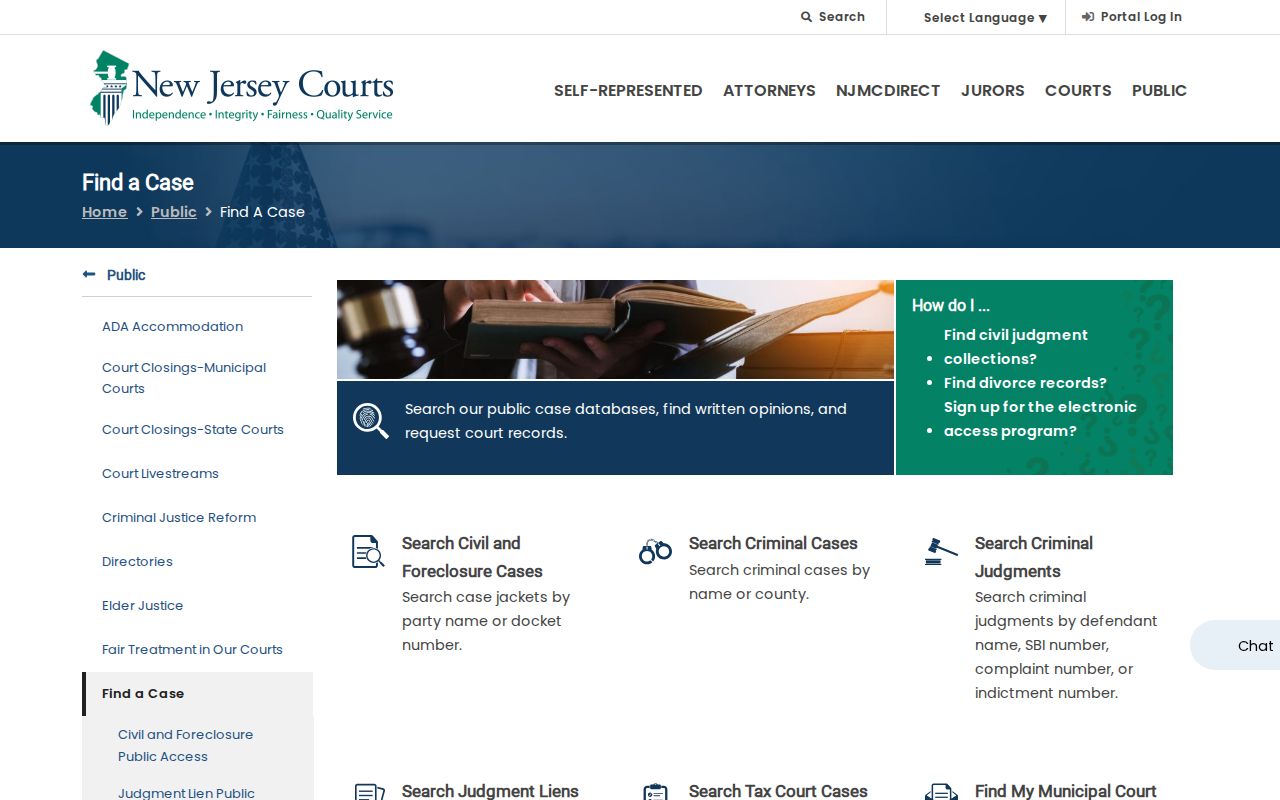
Choosing the right category before comparing names helps retain the venue and docket context needed for a later, defined request.
Use Rahway Vital Routes When a Resident Lookup Reaches an Event
New Jersey vital records are not an unrestricted name index. A current certified copy is available only to eligible requesters who meet the state’s relationship, identification, or authority rules. For genealogy, the state sets general thresholds of more than 80 years for births, 50 years for marriages, and 40 years for deaths, with the subject deceased. The date of the event controls the calculation.
Rahway’s local registrar at 1 City Hall Plaza handles eligible local genealogical requests. In-person genealogy requests have required an appointment since October 1, 2025; mail requests do not require one. The city lists $15 per certified copy effective November 4, 2025. The New Jersey DOH order route is the state alternative, while the State Archives and its Death Index serve discrete older series rather than the same request path.
The state vital-record order guidance explains the application, identity, and eligibility route.
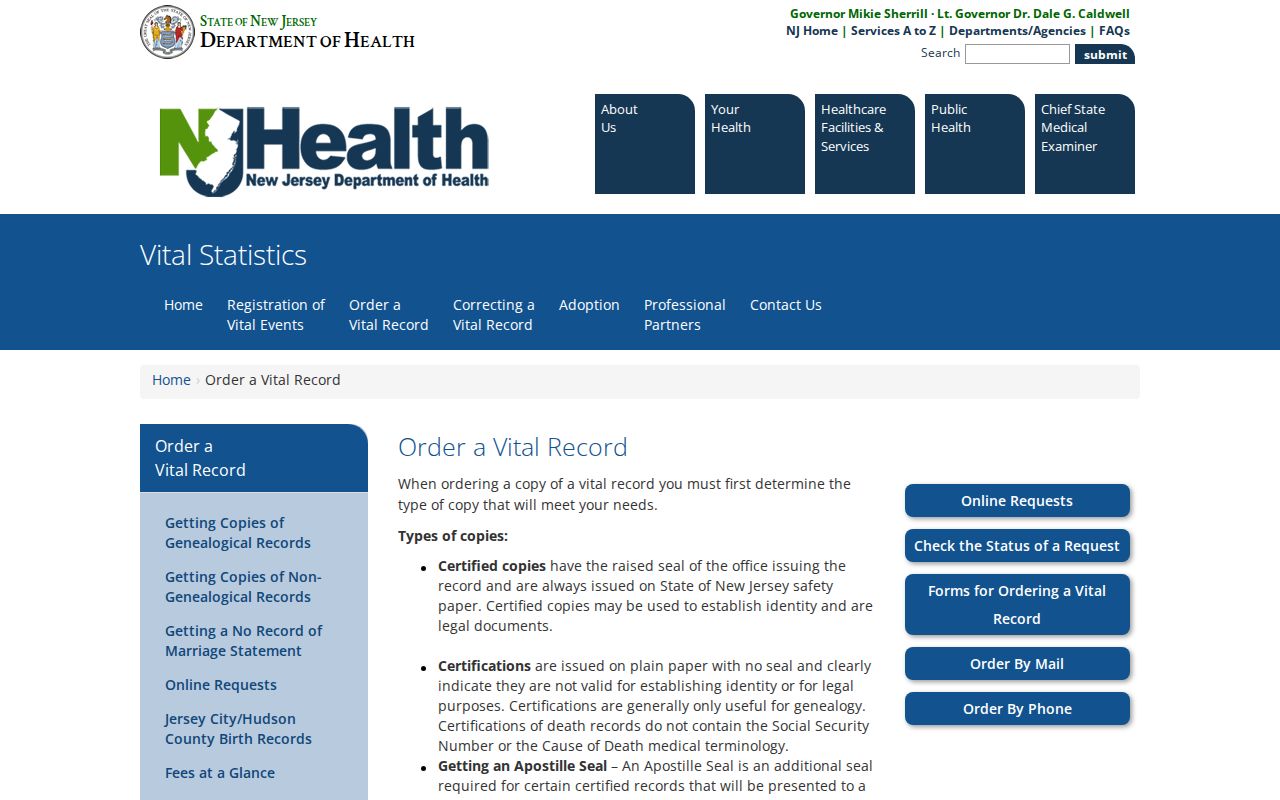
A vital-record result belongs in a Rahway research file as event evidence only after the proper copy category and requester eligibility have been confirmed.
The Rahway genealogical-records page is the local alternative for qualifying historical requests.
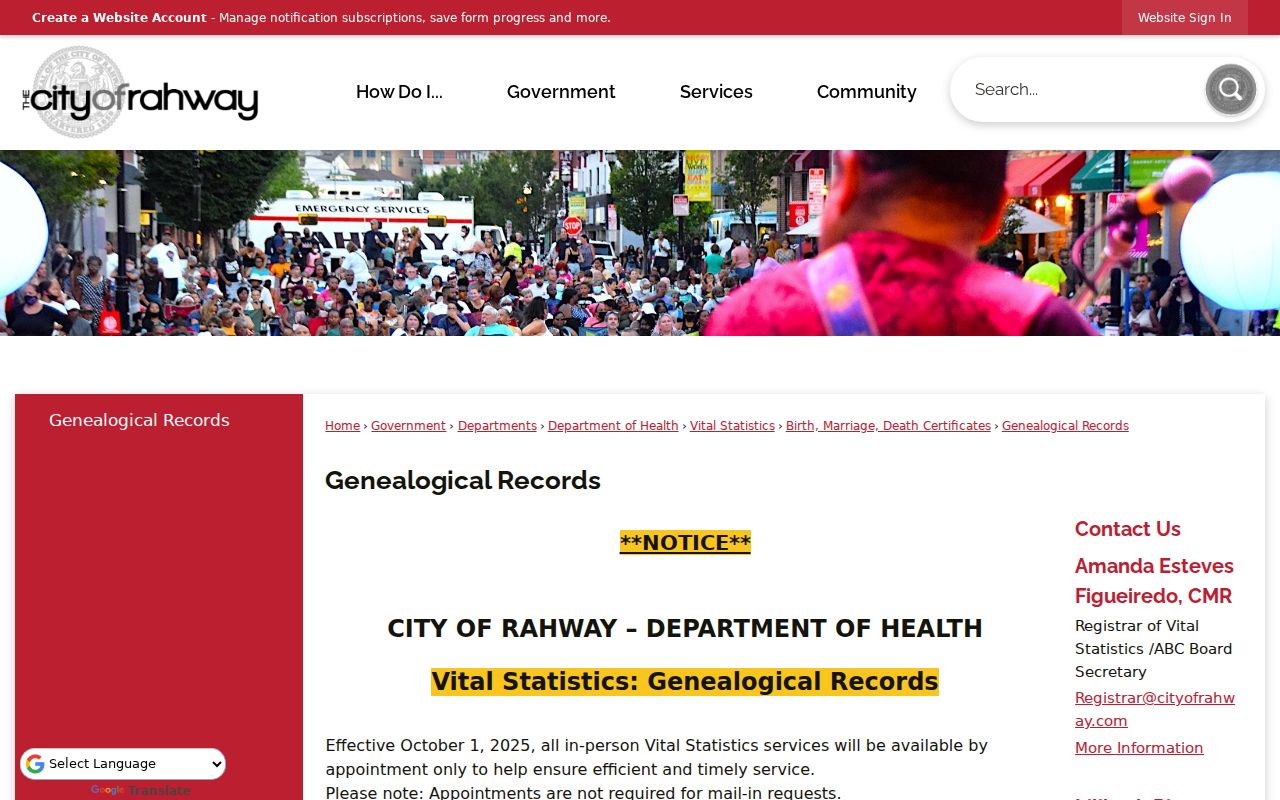
The local page keeps the appointment, mail, and fee details separate from the state’s broader vital-record ordering process.
Rahway Resident Lookup Sample Notes
Keep a compact inventory of what the source actually displayed. A deed result can supply party role, document type, recorded date, book/page or instrument number, and whether an image is available. A court jacket can supply category, party, venue, docket, caption, initiation date, and displayed status. For a historical vital-index lead, preserve the index name, county, year, and permit code if one appears.
- Docket
- A court’s identifying number for a case. It directs a requester to the court record, but it is not the case image or a finding about a person’s current circumstances.
- Index and image
- An index is a searchable listing or metadata record. An image is a view of the underlying filed or scanned material, and may be absent, restricted, or separately requested.
- Certified copy
- A custodian-issued copy with the certification required for the stated official purpose. It is different from an informational index entry or a plain certification.
For a dated name lead rather than a current claim, Rahway Public Library’s DigiFind-It collection and its local newspaper scans are useful primary material. Preserve the newspaper title, date, page, original spelling, and scan-versus-OCR distinction. The historical collections are also a good handoff to the Rahway Directory Book when the question becomes a year-by-year trail.
Keep the Rahway Resident Lookup Voter Step Personal
The New Jersey registration check is a status tool for the user’s own record, not a public neighborhood roster or an address-verification device. Search mismatches can arise from the county spelling, hyphens, spaces, married names, middle initials, or nicknames. A status result does not certify that a person now lives at an address.
Questions about public voter documents go to the Union County Board of Elections, with the requested file, election year or date range, municipality or district, and delivery format stated precisely. Signatures, Social Security numbers, driver-license or non-driver-ID numbers, and protected addresses are subject to redaction or restriction. The county and election rules, rather than a general online lookup, control the request.
The official voter registration check should be used only through its own secure, status-focused workflow.
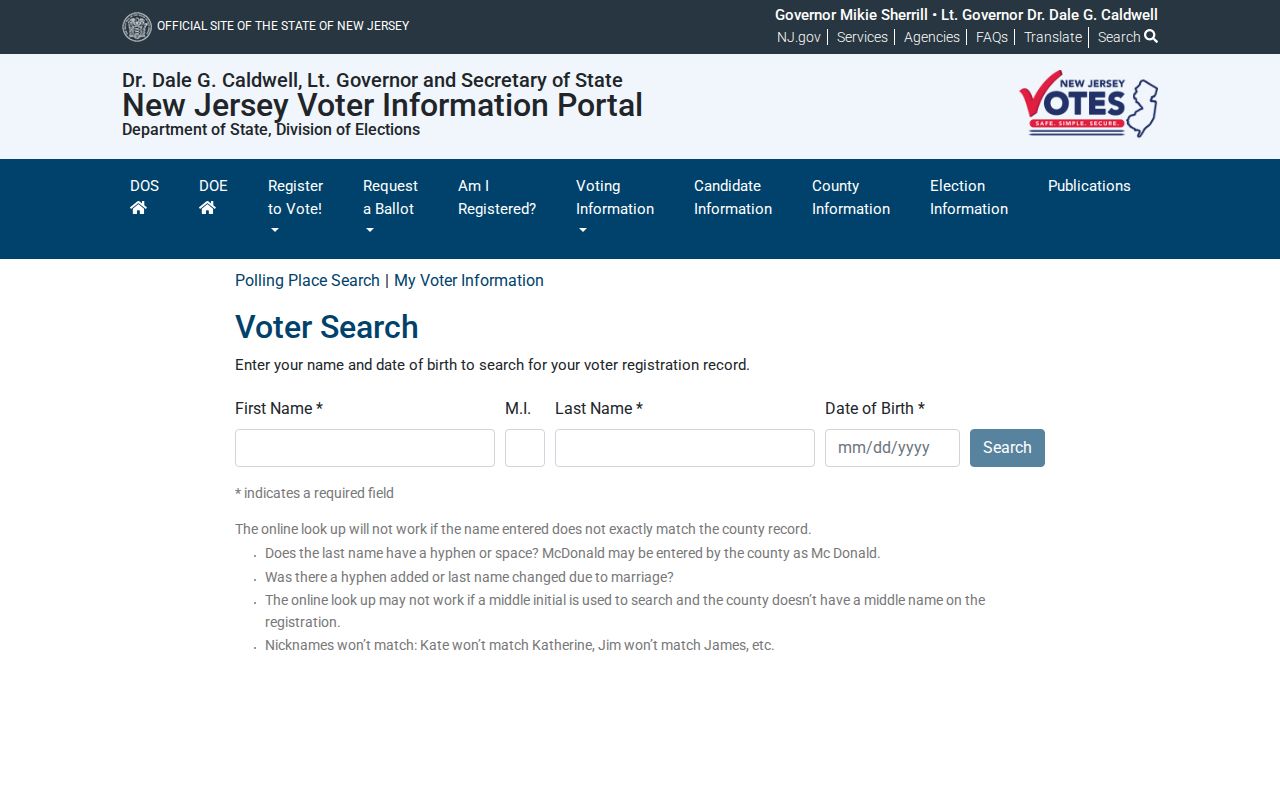
Keeping this step private prevents a single status screen from being stretched into a claim about another person or a complete voter file.
Request an Existing Rahway Record Through OPRA
New Jersey’s Open Public Records Act, N.J.S.A. 47:1A-1 et seq., provides a route to existing municipal records subject to exemptions and redaction. It does not require Rahway to answer a research question or create a new compilation. For a municipal record, name the specific record, address, block/lot if relevant, parties, and date range. That gives the custodian something identifiable to search.
Use Rahway’s OPRA request form for the defined item. A court record needs its docket and Judiciary request form instead; a land instrument needs the Clerk route; a vital event needs the registrar or state application. This office-by-office handoff is more accurate than trying to force every Rahway resident lookup through one form.
The Rahway OPRA form prompts a requester to describe an existing municipal record.
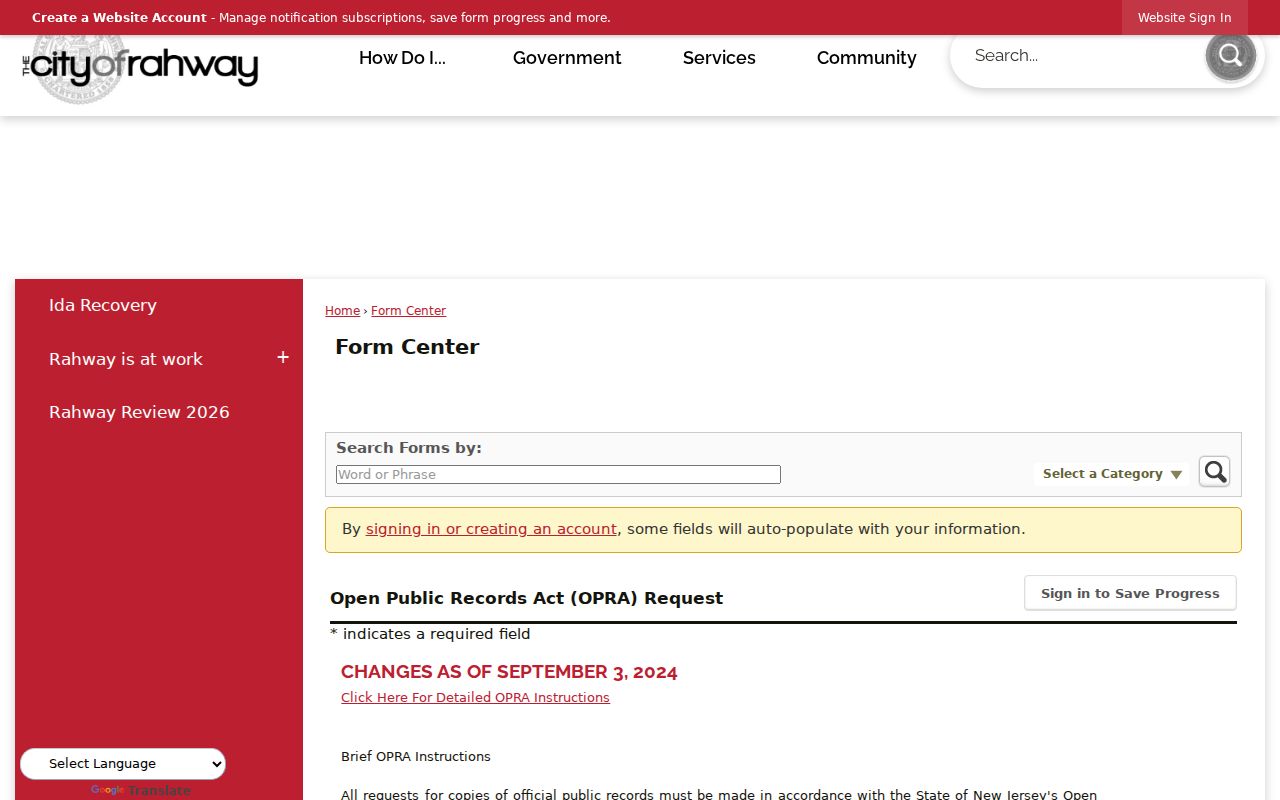
A specific description and date range help a custodian distinguish a proper record request from an open-ended question.
Limit a Rahway Resident Lookup to Lawful, Needed Details
Rahway records can include historical addresses, mailing addresses, entity addresses, and substitute addresses. Do not disclose a protected address or try to reconstruct one from other sources. New Jersey’s Address Confidentiality Program can provide an eligible participant with a substitute address, and Daniel’s Law can require removal or redaction of protected addresses from government websites.
The New Jersey Data Privacy Act, P.L. 2023, c.266 and N.J.S.A. 56:8-166.4 et seq., excludes public agencies and public-record data from its coverage. A private deletion request therefore does not erase an official deed, court, tax, or voter record. The right office and applicable confidentiality program control a correction or protection issue.
Lawful use. Use this Rahway research process for personal, lawful purposes and keep only the details needed to distinguish records. Do not use public material to stalk, harass, intimidate, or harm anyone.